Water-Damaged Hardwood Floors in Ottawa: Repair, Replace Boards or Replace the Floor?
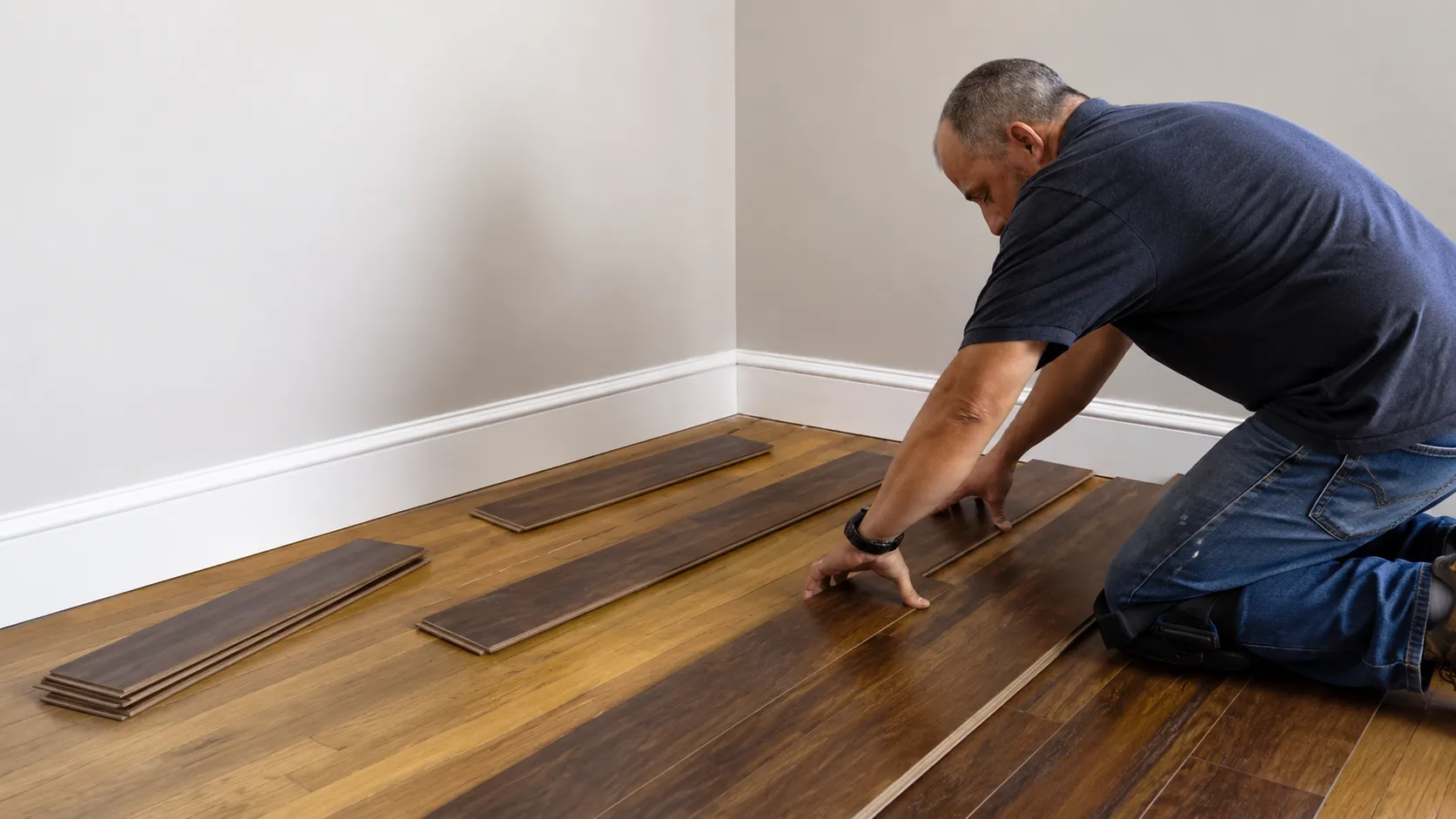
Water damage does not automatically mean a hardwood floor needs to be replaced.
A small dishwasher leak might affect a handful of boards. A larger plumbing failure can spread moisture underneath an entire room, including areas that still look dry from above.
The right repair depends on four things:
- how far the water travelled
- whether the flooring and subfloor have dried properly
- whether the wood remains structurally sound
- how much of the floor has actually failed
Before deciding whether to sand, replace individual boards or remove the entire floor, deal with the moisture problem first.
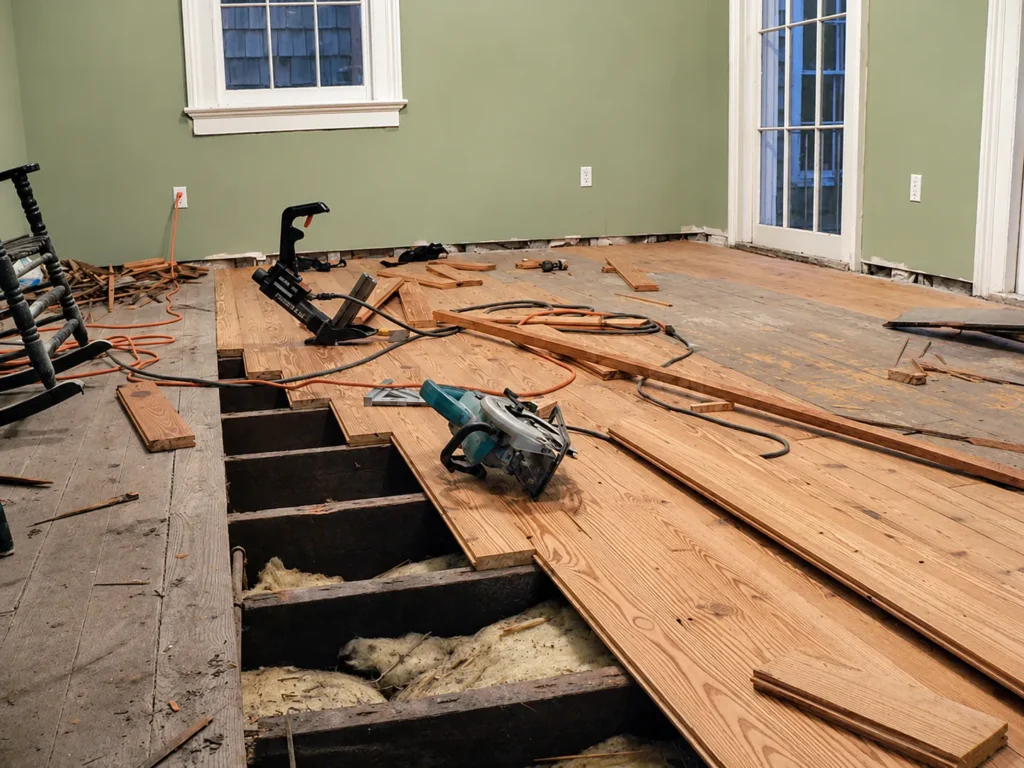
Start With the Water Source
The leak or other source of moisture needs to be stopped before flooring repair begins.
Remove standing water as soon as it is safe to do so and begin drying the affected area. This matters not only for the hardwood but also for the subfloor and surrounding building materials.
Health Canada recommends drying water-damaged materials quickly because prolonged dampness creates conditions that can support mould growth. Its guidance commonly refers to drying affected materials within about 48 hours where possible.
That does not mean a hardwood floor is automatically ready to sand or repair after two days.
Wood may take considerably longer to reach an appropriate moisture condition. Drying time varies based on:
- how much water entered the floor
- how long materials remained wet
- the type and thickness of the flooring
- whether the floor is solid or engineered hardwood
- the installation method
- the subfloor material
- indoor temperature and relative humidity
- airflow and dehumidification
- whether moisture travelled underneath the flooring
The important distinction is this:
Begin drying immediately, but base the repair decision on moisture condition and floor stability rather than the number of days that have passed.
A Floor Can Look Dry and Still Be Wet Underneath
Surface appearance tells only part of the story.
Water can move through board joints and spread underneath hardwood beyond the visible stain or damaged area. The surface may appear dry while the underside of the flooring or the subfloor remains damp.
The opposite can also happen. Hardwood that looks badly cupped shortly after a leak may improve substantially as moisture conditions return toward normal.
For that reason, a useful water-damage assessment should include moisture measurements rather than relying only on appearance or touch.
The National Wood Flooring Association recommends evaluating the moisture condition of the flooring, substrate and surrounding environment when assessing water-damaged wood floors.
Depending on the situation, an inspection may include:
- moisture readings in visibly affected hardwood
- readings in nearby flooring that appears unaffected
- moisture readings in wood subfloors
- indoor temperature and relative humidity
- inspection for swelling, movement or delamination
- checking whether boards remain securely attached
- identifying whether the flooring is solid or engineered
- confirming whether it is nailed, glued or floating
Unaffected flooring can provide a useful comparison because normal wood moisture levels vary with the home, season and indoor environment.
Moisture-meter readings need interpretation
A moisture meter is useful, but one number by itself does not diagnose a floor.
Meter type, wood species, material density, meter settings and the depth being measured can affect readings. A flooring professional should interpret the readings in the context of the floor and compare affected areas with appropriate reference areas.
Concrete also requires a different approach from wood.
A wood moisture meter reading used on plywood or hardwood should not simply be applied to a concrete slab. Concrete moisture conditions should be evaluated using an appropriate slab-testing method and compared with the requirements of the flooring, adhesive and moisture-control system being installed.
Where the Water Came From Matters
Not every water event should be treated the same way.
A recent appliance supply-line leak is very different from a sewage backup or contaminated floodwater.
Water from sources such as a supply line or localized plumbing leak may begin as relatively clean water. Floodwater, sewage and water containing biological or chemical contaminants require a different level of caution.
However, homeowners should also avoid assuming that water remains “clean” simply because of where it started.
Water can pick up contaminants as it travels through dirty building materials or remains in contact with flooring, insulation, wall cavities and other materials. The amount of time that has passed and the materials the water contacted can change the situation.
If sewage, floodwater or other contamination may be involved, treat the issue as more than a flooring repair.
The affected materials and contamination need to be assessed before deciding whether the hardwood can be refinished or reused.
Cupping and Buckling Are Not the Same Problem
These terms are sometimes used interchangeably, but they describe different conditions.
Cupping
Cupping occurs when the edges of a hardwood board sit higher than its centre.
It commonly develops when the moisture condition on one side of the board differs from the other. As moisture changes, the wood changes shape.
Cupping does not automatically mean the flooring needs to be replaced.
Minor distortion may improve as the floor dries. That is why sanding a recently water-damaged, cupped floor too early can create another problem.
If raised edges are sanded flat while the boards are still changing shape, the boards may change again as moisture conditions normalize, leaving the surface distorted.
Dry the floor first.
Once moisture conditions and board shape have stabilized, determine what distortion remains and whether sanding or another repair is appropriate.
Buckling
Buckling is more serious.
A buckled board has lifted away from the surface underneath or otherwise lost its normal attachment.
National Wood Flooring Association guidance indicates that flooring that has actually buckled generally requires replacement in the affected area because the attachment system is no longer performing as intended.
That does not automatically mean replacing the entire room.
The affected section should be investigated to determine why the flooring buckled and whether moisture or damage extends into the subfloor.
When Water-Damaged Hardwood Can Be Saved
Hardwood often remains usable after a limited water event if it dries properly and remains structurally sound.
Signs that existing flooring may be salvageable include:
- boards remain firm
- flooring stays securely attached
- cupping decreases during drying
- no significant buckling remains
- there is no visible decay
- engineered flooring has not delaminated
- the subfloor is dry and structurally sound
- moisture conditions have returned to an appropriate range
- the remaining damage is primarily cosmetic
A dark stain alone does not prove that a hardwood board has failed.
Wood can change colour while remaining structurally sound. Once the moisture issue has been resolved, staining, scratches, worn finish and uneven sheen become refinishing questions rather than moisture-remediation questions.
For dry, stable flooring with surface damage, hardwood floor refinishing in Ottawa may be enough to restore the floor.
When Individual Boards Should Be Replaced
Localized water damage often calls for localized repair.
Suppose an appliance leak permanently damages six boards but the rest of the room dries normally. There is usually no technical reason to remove an entire hardwood floor solely because those six boards failed.
Individual boards may need replacement when they have:
- buckled
- remained severely distorted after drying
- become soft or structurally weak
- cracked or broken
- developed damaged joints
- started to decay
- lost their proper attachment
- delaminated in the case of engineered flooring
- been removed to access damaged material underneath
Removing affected boards can also provide direct access to the subfloor.
That matters because water may have travelled farther underneath the hardwood than the visible damage suggests.
Localized damage can often be handled through hardwood floor repair in Ottawa rather than complete replacement.
Do Not Ignore the Subfloor
Hardwood is only the visible layer of the flooring system.
Underneath it may be plywood, OSB, concrete, underlayment, adhesive, sleepers or radiant-heating components.
Water can pass through hardwood joints and remain below the finished surface. The material underneath should therefore be considered before damaged boards are replaced or new flooring is installed.
Plywood
Excessive moisture can cause plywood to swell, distort or delaminate.
Plywood that became wet does not automatically require replacement. Its condition matters.
Material that remains structurally sound and dries appropriately may remain usable. Plywood showing significant delamination, loss of integrity or permanent distortion may need replacement.
Moisture measurements at multiple locations can help determine whether drying is progressing and whether hidden wet areas remain.
OSB
OSB can also swell after water exposure.
Limited wetting does not automatically make an OSB panel unusable. Severe swelling or deterioration, however, can affect the surface and may interfere with the ability of flooring fasteners to hold properly.
Damaged sections should be addressed before hardwood is reinstalled.
Concrete
Concrete does not respond to water in the same way as plywood or OSB, but moisture can remain within a slab.
This is particularly important for glued hardwood and engineered flooring.
Concrete should be evaluated using a testing method appropriate for the slab and flooring system. The results then need to comply with the flooring, adhesive and moisture-control manufacturer’s requirements before installation proceeds.
If deterioration is found below the hardwood, the subfloor should be repaired before finished flooring is put back.
Solid and Engineered Hardwood Need Different Assessments
The type of hardwood affects what can realistically be repaired.
Solid hardwood
Solid hardwood is milled from a single piece of wood.
Depending on its thickness and previous sanding history, it can often be refinished more than once during its service life.
That does not mean every water-damaged solid hardwood floor can simply be sanded.
Sanding is not the solution when:
- the flooring is still wet
- boards have buckled
- wood has started to decay
- the subfloor is damaged
- the flooring is unstable
- too little usable wood remains above the tongue
Engineered hardwood
Engineered hardwood consists of bonded layers with a real-wood wear layer at the surface.
Its repairability varies considerably by product.
Some engineered floors have enough wear layer to allow refinishing. Others have very limited sanding capacity. Significant moisture exposure can also affect internal layers or adhesive bonds.
Where possible, identify the manufacturer and product before sanding or repairing engineered hardwood.
Manufacturer-specific instructions should take precedence when they provide requirements for the particular flooring product.
What Common Symptoms Can Tell You
Visible symptoms are useful clues, but they are not complete diagnoses.
Dark staining
Dark staining does not automatically require board replacement.
First determine whether the wood remains firm, stable and appropriately dry.
A structurally sound board with surface staining may still be suitable for repair or refinishing.
If the wood itself has deteriorated, the situation is different.
Soft wood
Hardwood should remain structurally firm.
If a board has softened, lost strength or started to decay, sanding and refinishing will not restore its structural integrity.
The damaged material should be removed and the moisture source investigated.
Musty odour
A persistent musty or earthy smell is a reason to investigate further.
It does not prove by itself that mould is present, but Health Canada identifies musty or earthy odours as one possible sign associated with concealed moisture or mould.
Do not try to solve an unexplained odour simply by coating or refinishing the floor.
Find the source first.
Loose or moving boards
Movement may indicate damaged fasteners, adhesive problems, swelling or problems with the material underneath.
Boards that remain loose or continue moving after moisture conditions have stabilized deserve further investigation.
When Does the Whole Hardwood Floor Need Replacement?
Complete replacement makes sense when the damage itself is extensive.
Examples can include:
- buckling across a large portion of the room
- widespread attachment failure
- structural damage affecting many boards
- extensive decay
- large areas of damaged subfloor
- water damage across several connected spaces
- major delamination or bond failure in engineered flooring
- insufficient remaining wood for practical refinishing
- repairs that would require removing most of the floor anyway
A floor that looks dramatic immediately after a leak does not necessarily belong in this category.
The extent of replacement should be based on what remains damaged after the moisture source has been corrected, the floor has been assessed and drying has progressed.
When damage genuinely extends across most of the flooring system, hardwood floor replacement or installation may be the more practical option.
Refinishing Is the Final Step, Not the First
Refinishing deals with the visible surface of the wood.
It does not:
- dry wet flooring
- repair rotten material
- correct damaged subfloor
- restore buckled boards
- fix a plumbing leak
- remove contamination
- solve hidden moisture problems
For most water-damage situations, the repair sequence should look roughly like this:
- Stop the water source.
- Remove standing water safely.
- Begin drying affected materials.
- Consider the source of the water and whether contamination may be involved.
- Evaluate moisture conditions in the hardwood and material underneath.
- Identify the flooring construction and installation method.
- Repair damaged subfloor or substrate material where necessary.
- Replace hardwood boards that have structurally failed.
- Allow the flooring system to reach an appropriate and stable moisture condition.
- Sand and refinish only if the remaining floor is suitable.
Following that order avoids spending money on cosmetic work while a moisture or structural problem remains underneath.
What to Ask During a Water-Damage Inspection
A contractor assessing a water-damaged hardwood floor should be able to give clear answers to practical questions.
What type of flooring is installed?
Determine whether the floor is solid or engineered hardwood and whether it is nailed, glued or floating.
Where did the water come from?
A recent appliance leak and contaminated floodwater do not present the same risks.
How far did the moisture travel?
Visible staining may not show the full affected area.
Were moisture readings taken?
Readings from affected and suitable comparison areas provide more useful information than simply saying the floor “looks dry.”
Ask what was measured, where readings were taken and how those readings were interpreted.
Was the subfloor or substrate checked?
Moisture or deterioration underneath the hardwood can substantially change the repair plan.
Are the boards cupped or actually buckled?
Cupping may improve as moisture conditions normalize.
Buckling generally indicates that the affected flooring has lost its proper attachment and requires a different repair.
Is the wood structurally sound?
Colour change and structural failure are different issues.
Is the floor actually ready to refinish?
That decision should depend on moisture condition, stability, flooring construction and the amount of usable material remaining rather than simply how much time has passed since the leak.
When to Bring in a Flooring or Restoration Professional
A small spill cleaned up immediately is one thing.
A plumbing failure that soaked a flooring assembly for several hours is another.
Professional assessment becomes more important when:
- hardwood has buckled
- the subfloor remains wet
- moisture extends beyond the visibly affected area
- several rooms are involved
- visible mould is present
- a persistent musty odour remains
- the flooring has remained wet for an extended period
- sewage or floodwater may be involved
- water entered floor, wall or ceiling cavities
- effective drying cannot be achieved with ordinary household methods
- the flooring construction is unknown
- significant engineered-flooring delamination is suspected
Health Canada recommends professional involvement in situations including significant mould problems, contaminated water, suspected hidden mould and flooding that has entered building cavities that may not dry adequately through ordinary methods.
Common Questions About Water-Damaged Hardwood Floors
Can water-damaged hardwood flooring be repaired?
Often, yes.
A limited leak may require drying, moisture assessment, replacement of several damaged boards and refinishing rather than complete floor replacement.
The important part is determining the actual extent of the damage after the moisture source has been stopped and the flooring system has been assessed.
How long should hardwood dry after a leak?
There is no universal number of days.
Drying should begin immediately, but the floor may need considerably longer than 48 hours before it is suitable for sanding or repair.
Use moisture condition and floor stability rather than the calendar.
Should cupped hardwood be sanded immediately?
Usually not.
Cupping caused by moisture may lessen as the boards dry. Sanding while the flooring is still changing shape can remove wood unnecessarily and leave the floor distorted later.
Does buckled hardwood need to be replaced?
The affected buckled boards generally do.
Buckling indicates that the flooring has lifted or lost its normal attachment. The cause of the buckling and the condition of the material underneath should also be addressed before replacement.
Do dark water stains mean the boards are ruined?
Not necessarily.
Check whether the wood remains firm, stable and appropriately dry.
Some staining is cosmetic and may be addressed during refinishing. Softness, decay or structural deterioration requires a different repair.
Can only the damaged boards be replaced?
Yes, when the damage is genuinely localized and the surrounding hardwood and subfloor remain sound.
Matching an older floor may require considering:
- species
- width
- thickness
- milling profile
- grade
- installation method
- finish
Even when the material matches, some colour variation may remain because existing hardwood changes with age, sunlight and previous finishes.
Will refinishing fix water damage?
Refinishing can correct some surface damage after the flooring is dry, stable and structurally sound.
It cannot fix:
- rot
- buckling
- damaged subfloor
- trapped moisture
- failed engineered-flooring layers
- contaminated material
When does the entire floor need replacement?
Usually when damage is widespread enough that localized repair no longer makes practical sense.
That may include extensive buckling, structural failure across many boards, widespread subfloor damage or large areas of failed engineered flooring.
A small water event by itself is not a reason to replace an entire hardwood floor.
Repair or Replace? Let the Condition of the Floor Decide
Most water-damaged hardwood floors can be evaluated by answering four questions:
Has the water source been fixed?
Have the flooring and material underneath been properly assessed for moisture?
Are the hardwood and subfloor still structurally sound?
How much of the floor has actually failed?
Sound flooring does not need to be removed simply because it became wet.
Failed boards can often be replaced individually.
Damaged subfloor should be repaired before finished flooring goes back over it.
Broader replacement becomes appropriate when the damage itself is broad.
For an assessment involving water-damaged hardwood, localized board replacement, subfloor problems or refinishing, see water-damaged hardwood floor repair in Ottawa.