Luxury Vinyl Plank Flooring in Ottawa: What Matters Before You Buy
Luxury vinyl plank is often sold with a reassuring trio of claims: waterproof, durable and easy to install. None is entirely wrong. None tells you whether a particular floor will perform well in your home.
The useful questions begin after the colour and plank size have been chosen. What is beneath the floor? How much moisture is present? Will the room stay heated through winter? What does the manufacturer require at walls, doorways and fixed cabinets? Those details are more likely to determine the life of the floor than the brand name printed on the carton.
That is especially true in Ottawa. From late fall through spring, boots and pets carry in water, road salt and abrasive grit. Basements add another set of risks: moisture moving through concrete, old cracks, uneven slabs and occasional water entry. LVP can be a sensible choice in those conditions, but it is not a remedy for them.
“Waterproof” Describes the Plank, Not Necessarily the Room
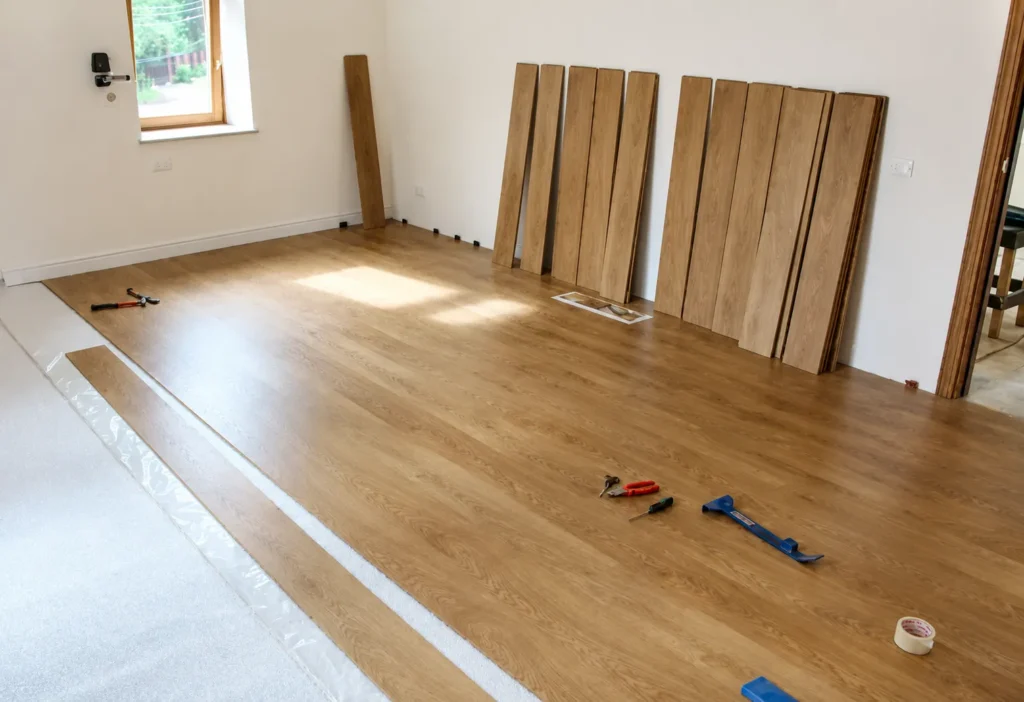
A vinyl plank may resist swelling when water reaches its surface. The completed floor is a different matter. Water can travel through joints or around the perimeter and become trapped underneath, where it may damage plywood, underlayment, drywall or other parts of the building.
Karndean’s January 2024 rigid-core installation guide makes this distinction reasonably clear. For the products covered by that guide, the flooring will not absorb, swell or suffer water damage during normal use. The instructions still call for topical spills to be cleaned promptly, and they exclude continually wet rooms.
For a kitchen or entrance, that may be perfectly adequate. For a bathroom, laundry room or basement, ask the retailer to show you what the warranty says about water below the flooring, perimeter sealing and flooding. If the answer is simply “the product is waterproof,” the important question has not been answered.
LVP is good at handling ordinary spills. It cannot repair a leaking appliance, stop water entering through a foundation or turn a poorly detailed bathroom into a waterproof assembly.
Start With the Basement, Not the Flooring Sample
Before covering a basement slab, inspect the room for stains, efflorescence, musty odours, condensation, active leaks and evidence of previous flooding. Health Canada recommends addressing the source of a moisture problem instead of covering the affected area. A new floor can hide warning signs for a while, but it cannot make them disappear.
Once obvious problems have been dealt with, check the installation guide for the exact product being considered. It should tell you whether the flooring is approved below grade, which concrete-moisture test to use, what result is acceptable and whether a separate moisture-control system is required.
A taped-down sheet of plastic may reveal an obvious moisture problem, but it is not a substitute for a test required by the warranty. Record the test method and result before installation. That documentation matters if the floor later develops movement, odour or adhesive failure.
The slab also needs to be flat. “Rigid core” sounds forgiving, but a plank can still rock across a high spot or flex over a depression. Over time, that movement can stress the locking joints. Levelling and patching are not incidental extras. In some rooms, they are the most important part of the job.
One Installation Guide, in Concrete Terms
Generic advice such as “leave an expansion gap” is not enough. The gap, test method and temperature limits must come from the current guide for the product on the quote.
For example, Karndean’s January 2024 rigid-core plank and tile guide gives the following requirements for the products it covers:
| Item | Requirement in this guide |
|---|---|
| Installation | Floating click system |
| Room temperature during installation | 18°C to 27°C |
| Residential acclimation | Usually unnecessary within that range; required after exposure to extreme temperatures |
| Maximum subfloor variation | 5 mm over 3 m |
| Approved concrete-moisture tests | ASTM F1869 or ASTM F2170 |
| Korlok Select moisture limit | 8 lb per 1,000 sq. ft. per 24 hours, or 95% RH |
| Minimum expansion gap | 5 mm |
| Gap in areas larger than 100 m² | 8 mm |
| Separate underlayment | Not normally recommended |
| Maximum radiant-floor interface temperature | 27°C |
These are not universal LVP specifications. A different collection from the same manufacturer may have different limits. Glue-down and loose-lay products require different planning again.
Large windows and unheated rooms deserve particular attention. Strong sunlight can raise the floor temperature well above the room’s air temperature, while an enclosed porch or seasonal addition can experience a much wider temperature swing than a living room. Some products require larger expansion spaces or other precautions in those conditions. Others may not be approved at all.
What LVP Does Well and Where the Trade-Offs Appear
In the right room, LVP is practical. Routine spills are easy to clean, and the floor does not have the seasonal movement or refinishing needs of real wood. Floating, glue-down and loose-lay systems offer options for different substrates and repair plans. Some products also include an attached backing, which can simplify the assembly.
The compromises are less dramatic than the marketing claims, but they are worth understanding. LVP can scratch under grit, dent beneath heavy furniture and discolour in contact with incompatible mats or cleaners. It reproduces wood or stone with a printed layer. It will not develop the natural variation of wood, and it cannot be sanded and refinished.
Repairs depend heavily on the installation system. A damaged glue-down plank can sometimes be lifted and replaced, although removing the adhesive and preparing the exposed area takes care. Replacing a floating plank may mean disassembling the floor from the nearest accessible wall. Ask how a repair would be done in your room before assuming that individual boards are easily replaceable.
The following comparisons are broad tendencies, not guarantees. Performance varies by product, installation and room conditions.
Tile surfaces generally tolerate water well, but the substrate, grout, joints and waterproofing details still matter. Engineered hardwood provides a real wood surface but usually requires quicker attention to water. Laminate varies considerably by product. Carpet offers warmth and softness but is a poor match for recurring moisture.
There is no meaningful category winner without knowing the room, substrate and homeowner’s priorities.
Ottawa Winter Care Is Mostly About Grit Control
The City of Ottawa uses dry salt, wet salt, liquid brine and abrasive materials such as grit during winter road maintenance.
Salt residue is visible and annoying, but grit presents the more immediate scratch risk. At a busy entrance, use enough matting for several steps, then sweep or vacuum before damp cleaning. Otherwise, the mop can drag abrasive particles across the wear layer.
Choose non-staining mats and check the care guide before using rubber-backed products or general household cleaners. Put suitable protectors beneath furniture and inspect them periodically. A felt pad with grit embedded in it becomes a small piece of sandpaper. Wet boots should be kept on a tray rather than left directly on the floor.
This is not a special defect of vinyl. Hardwood, laminate and tile also benefit from an entrance that captures water and grit before they spread through the house.
What a Useful Flooring Quote Should Contain
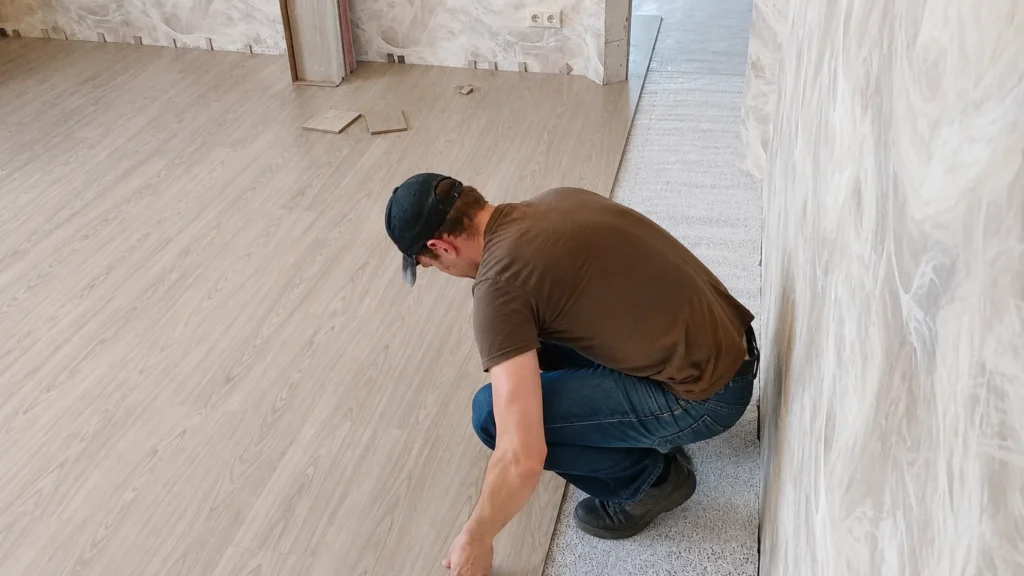
“Supply and install vinyl plank” is not a sufficient scope of work. Before accepting a quote, make sure it identifies:
- The manufacturer, collection and product code
- The installation method and current guide revision
- The required flatness and moisture tests
- Any levelling, crack repair or moisture-control work included in the price
- The approved underlayment or attached backing
- The expansion and transition plan, including cabinets, islands, doors and stairs
- Removal, disposal, trim and door-cutting charges
- The material and labour warranties
- Who is responsible if the substrate fails a required test
It is also worth asking how a damaged plank would be replaced after the room is furnished. The answer may change which installation system makes sense.
A Note About Older Floors
Some older tiles, backing materials and adhesives contain asbestos. Do not sand, grind, scrape or mechanically remove a suspect material before it has been assessed.
Health Canada advises homeowners to avoid disturbing possible asbestos-containing materials and to hire a professional to test them before renovation. Confirmed asbestos should be handled by qualified workers.
The Decision
LVP can be a suitable choice for Ottawa kitchens, entrances, finished basements and family rooms, provided the selected product and installation system match the conditions.
The decision should rest on three pieces of evidence:
- The product is approved for the room.
- The substrate meets the product’s requirements.
- The quoted installation follows the current manual.
Choose the exact product before relying on labels such as “waterproof,” “pet-friendly” or “easy to install.” Then compare its manual, warranty, preparation cost and repair method with the alternatives.
The floor itself is only one part of the purchase. The work underneath it is what usually determines whether it still feels like a good choice years later.